🚚 Food truck business — investment, profit & project report
Plan a mobile food-truck operation: truck fabrication, kitchen equipment, daily meals, pitch fees, break-even and 5-year profit. Currency-aware (₹/$/€/£/¥ — pick from the header dropdown). Includes downloadable project report in Word & PDF for loan applications.
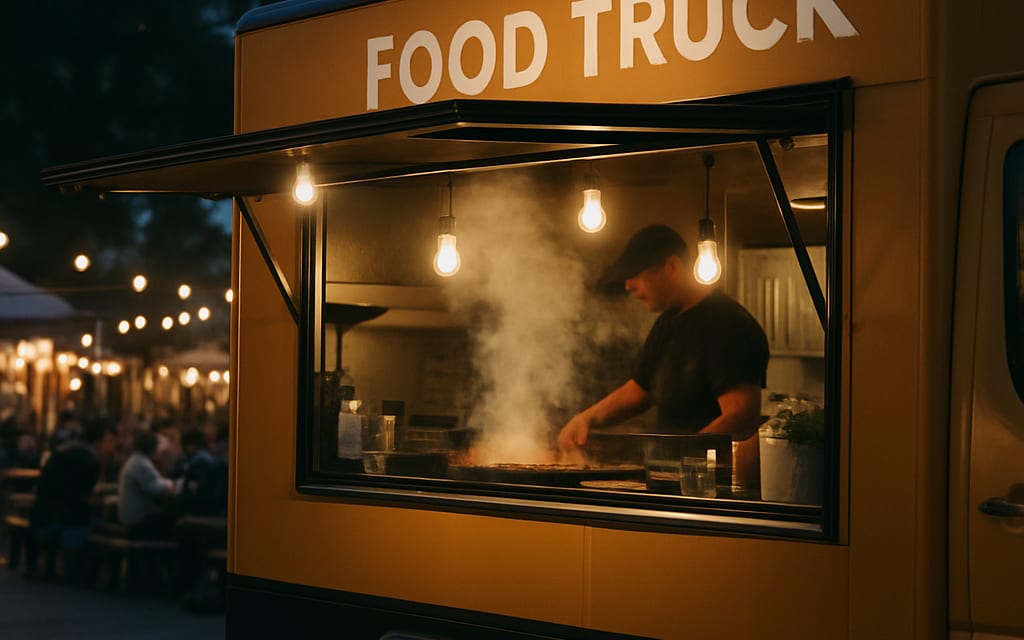
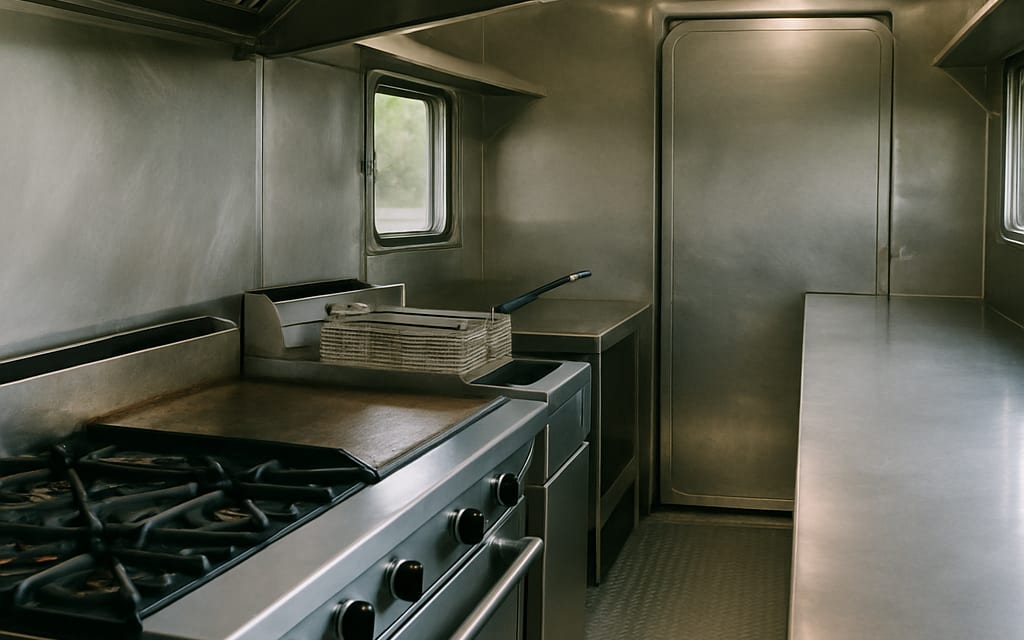
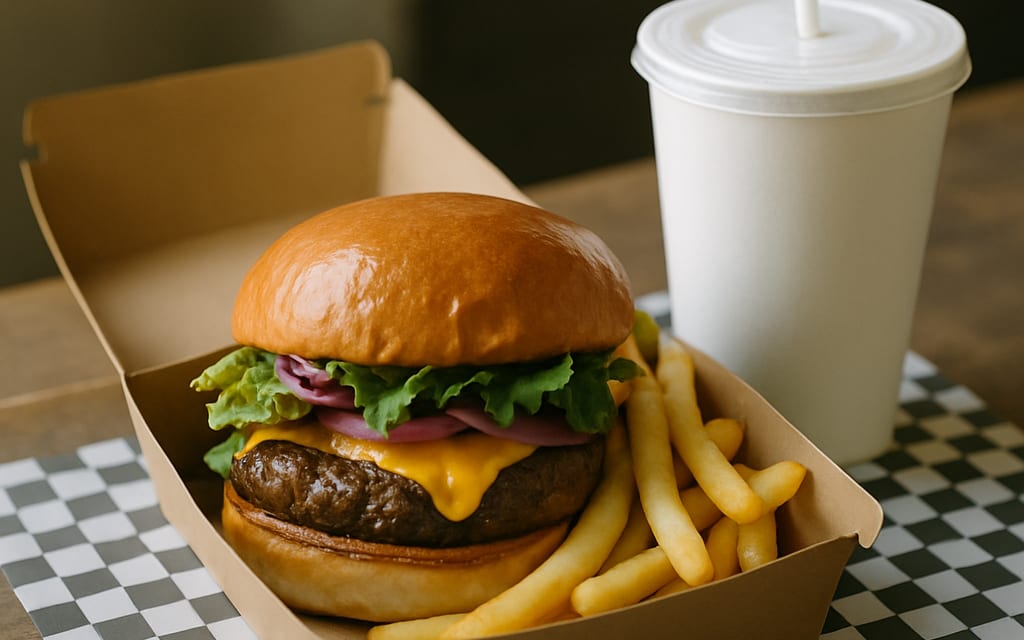
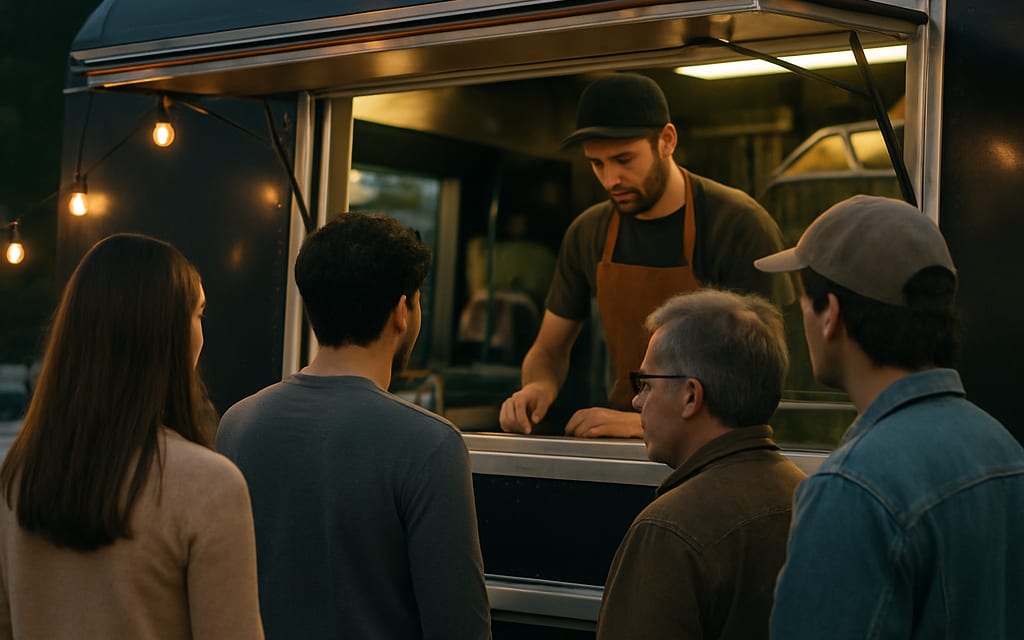
📸Gallery
📋Eligibility — by region
🇮🇳India
- FSSAI Mobile food-business license mandatory. Municipal hawker / vendor permit from the local corporation.
- RTO commercial-vehicle registration + commercial driving licence for the truck. GST registration if turnover > ₹20L/year.
- Local fire-safety NOC for LPG cylinders on-board. Pollution-under-control (PUC) certificate for the vehicle.
🇺🇸USA
- City Mobile Food Vendor Permit + state health-department inspection. Commissary requirement (no home food prep) in most states.
- Food-handler card (ServSafe or equivalent) for all staff + city occupational / business licence.
- Vehicle DMV commercial registration + LPG / propane safety inspection. Zoning compliance for daily pitches.
🇬🇧UK
- Local council street-trading consent + FSA food-business registration (28 days before opening).
- EHO (Environmental Health Officer) inspection — target Food Hygiene Rating 4 or 5. Hot Food Trader's licence where required.
🇪🇺EU
- Country mobile food-business permit + EU Reg 178/2002 (general food law) + Reg 852/2004 (hygiene) compliance.
- Local market-day fees + HACCP plan + allergen labelling (FIC Regulation 1169/2011).
🌏Australia / Canada / others
- AU: Council mobile food-business permit + state Food Act notification + ServSafe-equivalent trainer.
- CA: provincial mobile food premises permit + Health Canada food-safety + municipal vending licence.
🏗️Setup requirements (capex breakdown)
Edit any value to match your local prices — totals update live and flow into the calculator below.
| Item | Specification | Cost (₹) |
|---|---|---|
| Truck / cart fabrication | Vehicle + sheet-metal kitchen body | |
| Kitchen equipment | 4-burner gas + griddle + fryer + chimney | |
| Refrigeration | Refrigerator + chest freezer + ice machine | |
| POS + billing + packaging | Tablet POS, printer, disposables supply | |
| Branding + wrap + generator | Truck wrap, signage, backup genset | |
| Working capital (1 month) | Ingredients + fuel + initial wages | |
| Total capex | ₹9,00,000 | |
| Year | Revenue | Cost | Profit | Cumulative |
|---|
⚠️Risks & mitigation
- Weather dependence: Open-air pitches lose 30–50% revenue on rainy days. Mitigate with covered pitches, awning, and a secondary indoor catering line for monsoon months.
- Pitch eviction / policy shifts: Civic authorities can revoke vendor zones overnight. Keep 2–3 alternate approved locations rotation-ready; cultivate ties with mall / tech-park admins for private pitches.
- Truck breakdowns (single-asset risk): One mechanical failure stops 100% of revenue. Carry a service-AMC, keep ~5% of capex as repair buffer, and pre-identify a backup rental cart.
- Trend churn: Social-media-driven cuisine fads shift quickly. Test new menu items monthly; track per-item margin and prune cold sellers within 4 weeks.
💰Funding & support programs
🇮🇳India
- PM-SVANidhi street-vendor scheme: graded ₹10k → ₹20k → ₹50k working capital loans at subsidised interest with 7% subvention.
- PMFME (Pradhan Mantri Formalisation of Micro Food Enterprises): 35% credit-linked subsidy up to ₹10L for food micro-units including mobile.
- MUDRA Kishore / Tarun: ₹50k–₹10L collateral-free working capital + asset loans for micro-enterprises.
- State schemes: Maharashtra Mahila Udyog, Karnataka MSME subsidy, Tamil Nadu NEEDS — vary by state.
🇺🇸USA
- SBA Microloan: up to $50k for equipment, truck and working capital at low fixed rates.
- USDA Rural Business Development Program (BDP): for rural-route mobile food trucks serving small communities.
- State minority-business grants: California GO-Biz, NYC SBS, Texas Economic Development for first-time food entrepreneurs.
🇬🇧UK
- Start Up Loans: £500–£25k at 6% APR for new food-truck businesses across England, Scotland and Wales.
- Prince's Trust Enterprise Programme: grants + mentoring + low-interest loans for 18–30-year-old founders.
- Council high-street-regeneration grants: match-funding for mobile traders activating town centres.
🇪🇺EU
- Country micro-finance: ADIE (France), KfW StartGeld (Germany), Microbank (Spain) — €5k–€25k loans.
- EU LIFE Programme: grants for eco / electric food trucks reducing urban emissions.
🌏Australia / Canada
- AU NEIS (New Enterprise Incentive Scheme): income support + mentoring + small-business training for first-time founders.
- CA Futurpreneur: 0% loans up to $20k for under-39 founders, plus BDC matching for $40k total.
📄Generate project report (Word + PDF)
Fill in your details — defaults are pre-populated. Click Print as PDF for a browser-printable PDF or Download Word for an editable .docx file usable in bank loan applications.
❓FAQ
What's the minimum investment to start a food truck?
A bare-bones cart with second-hand equipment can launch around ₹3L, but a properly fabricated truck with reliable kitchen kit, branding and 1-month working capital lands at ₹8L–12L. Skimping on the truck body or refrigeration is the #1 source of first-year losses.
How many meals per day do I need to break even?
At ₹180 avg ticket and 35% food cost, you need roughly 60–80 meals/day for 26 days to cover monthly costs on a 10-lakh setup. Lunch-rush tech-park pitches comfortably do 100–150; weekend market pitches average 60–90.
Do I need a commercial kitchen / commissary?
In the US and most of the EU — yes, home prep is illegal. You must use a licensed commissary for storage and prep. In India, on-board prep is allowed under FSSAI Mobile licence provided potable water + waste-water tanks are fitted.
How do I choose a pitch location?
The 3-test rule: (1) foot-traffic count > 300 people/hour during your meal window, (2) no more than 2 direct competitors within 100m, (3) formal permission (or applied-for) from civic / private-property authority. Avoid pitches with no permit pathway — eviction is just a matter of time.
Truck vs cart vs container kitchen — which?
A cart (₹2–4L) suits single-cuisine high-volume items (chai, momos). A truck (₹8–15L) suits multi-item menus and mobility. A container kitchen (₹6–10L, static) suits a fixed lease pitch with overnight storage. Start with a cart only if your menu is < 6 SKUs.