🧂 Spice grinding business — investment, profit & project report
Plan a semi-urban or village-level spice grinding unit: pulveriser capex, daily kg output, raw whole-spice cost, packaging, monthly revenue, break-even and 5-year profit. Currency-aware (₹/$/€/£/¥ — pick from the header dropdown). Includes downloadable project report in Word & PDF for loan applications & PMFME subsidy.
📸Gallery
📋Eligibility — by region
🇮🇳India
- FSSAI license mandatory (basic <₹12L; state ₹12L–20Cr; central >20Cr). Agmark optional but adds value for ground spices.
- MSME Udyam for PMFME / PMEGP subsidy eligibility. GST mandatory above ₹40L turnover (₹20L NE).
- BIS standards (IS 2356 chilli powder, IS 3580 turmeric, IS 1797 coriander etc.) — voluntary but mandatory for govt tenders.
🇺🇸USA
- FDA food-facility registration (biennial). USDA Whole Spices Grading for imported raw material.
- FSMA preventive controls rule applies — PCQI on staff, written food-safety plan, sanitation SOPs.
🇬🇧UK
- FSA food-business registration 28 days before trading. EHO inspection + hygiene rating.
- Allergen labelling per Natasha's Law + sulphite declarations (common in dried spices).
🇪🇺EU
- EU Reg 178/2002 general food law + Reg 1881/2006 mycotoxin limits (aflatoxin B1 max 5 µg/kg for spices; ochratoxin A 15 µg/kg).
- Sudan dye / pesticide residue testing under RASFF — non-compliant lots will be rejected at port.
🌏Australia / Canada / others
- AU: FSANZ food standards + state food act licensing. CA: CFIA registration + provincial food premises permit.
🏗️Setup requirements (capex breakdown)
Edit any value to match your local prices — totals update live and flow into the calculator below.
| Item | Specification | Cost (₹) |
|---|---|---|
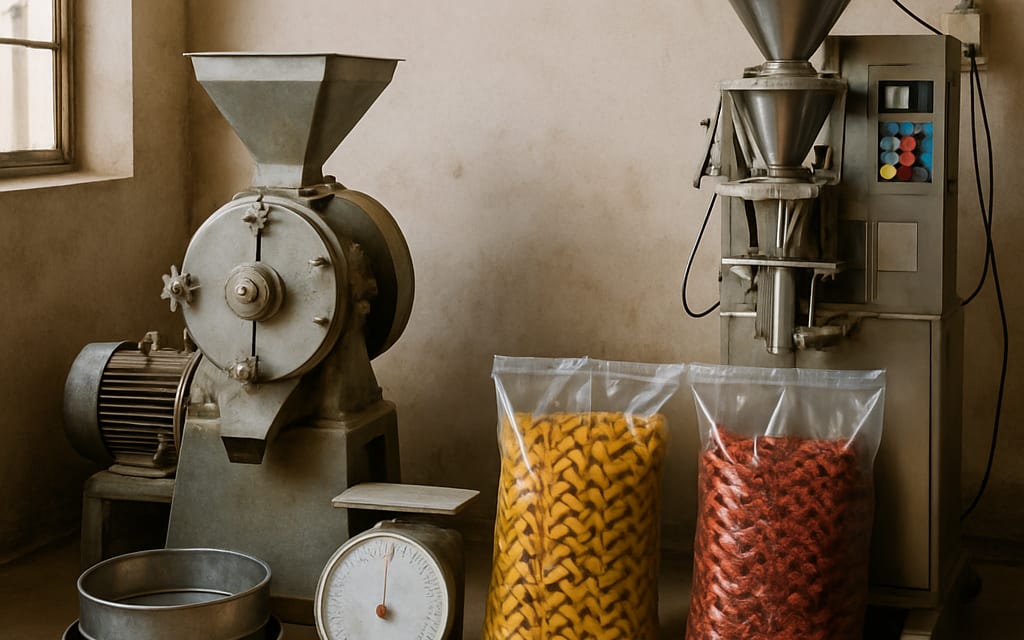
| Spice grinder + pulveriser + sieve | 5 HP pulveriser + vibrating sieve | |
| Raw material initial bulk stock | Chilli + turmeric + coriander + cumin | |
| Packaging machine + sealer + label printer | Auger filler + induction sealer | |
| Storage bins + weighing scale | Food-grade SS bins + 100kg digital scale | |
| Shop deposit + 3-phase electrical | Rent deposit + 3-ph connection + earthing | |
| Working capital | 1.5 months running costs | |
| Total capex | ₹3,80,000 | |
| Year | Revenue | Cost | Profit | Cumulative |
|---|
⚠️Risks & mitigation
- Whole-spice price volatility: Chilli & turmeric APMC prices swing 30–70% year-on-year. Lock in 3–6 month forward contracts at harvest peak; use multi-spice product mix to smooth margins.
- Aflatoxin / mycotoxin contamination: EU rejects lots above 5 µg/kg aflatoxin B1. Source from clean drying yards, store <65% RH, batch-test before grinding.
- Dust hazard / respiratory risk: Chilli and pepper dust irritates lungs and skin. Mandatory N95 masks, exhaust hoods, and dust-extraction cyclones — also reduces fire/explosion risk.
- Big-brand competition: Everest, MDH, Catch dominate organised retail. Compete via regional flavours (e.g. Guntur chilli, Erode turmeric), B2B HoReCa supply, or private-label contracts.
💰Funding & support programs
🇮🇳India
- PMFME (PM Formalisation of Micro Food Enterprises): 35% credit-linked back-end subsidy up to ₹10L — ideal for spice micro-units.
- KVIC PMEGP: 15–35% margin-money grant for first-time entrepreneurs.
- MUDRA Tarun: ₹5L–10L collateral-free loan under PMMY.
- Spices Board India schemes: infrastructure subsidy, post-harvest grants, export incentives.
- ASIDE grants: Assistance to States for Infrastructure Development for Exports — for export-quality processing.
🇺🇸USA
- USDA Specialty Crop Block Grant Program: grants for specialty-crop value-add (spices qualify).
- SBA 7(a) Loan: up to $5M for equipment + working capital.
- USDA Value-Added Producer Grant (VAPG): up to $250k for producers adding value to raw farm goods.
🇬🇧UK
- Start Up Loans: £500–£25k at 6% APR for new food businesses.
- Innovate UK Agri-Tech Catalyst: co-funded innovation grants for processing technology.
🇪🇺EU
- CAP rural-development: processing & marketing co-financed grants (40–75%).
- Country specialty-crop schemes: Spain PDO/PGI grants, Italy Filiere, Hungary VP intensification.
🌏Australia / Canada
- AU: AgriFutures emerging-industries grants.
- CA: AgriInnovate Program — interest-free repayable contributions up to CA$10M for agri-food processing.
📄Generate project report (Word + PDF)
Fill in your details — defaults are pre-populated. Click Print as PDF for a browser-printable PDF or Download Word for an editable .docx file usable in bank loan applications.
❓FAQ
Which spices give the best margin?
Margins (gross) typically: turmeric 30–40%, chilli 25–35%, coriander 20–30%, cumin 18–28%. Specialty blends (garam masala, sambar powder) reach 45–60%. Start with a 3-SKU lineup of fast-movers, then layer blends.
What's the realistic daily output for a small unit?
A 5 HP pulveriser with one operator processes 40–70 kg/day of medium-hardness spice (chilli, coriander). Turmeric requires polishing first. With 26 working days, expect 1000–1800 kg/month.
How do I avoid aflatoxin rejection for export?
Source whole spice from cemented drying yards (not roadside), keep moisture <10%, store in low-RH warehouse, and lab-test every lot (₹500–₹1500 per test) before grinding. Reject any lot above 4 µg/kg aflatoxin B1 to stay safely under EU's 5 µg/kg limit.
Can I sell direct to consumers / online?
Yes — D2C is growing fast. List on Amazon / Flipkart / district e-commerce sites with FSSAI-compliant labels. D2C margins are 2–3× wholesale but you carry marketing + last-mile cost. A 70/30 B2B-D2C mix is typical for small grinders.
How much electricity does a spice pulveriser use?
A 5 HP pulveriser pulls ~3.7 kW under load. Running 6 hours/day × 26 days ≈ 580 kWh/month. At ₹8/kWh industrial tariff, that's ~₹4,600/month. Larger 10 HP units roughly double this.